Treasury Management System (TMS): A Complete Guide for Modern Corporates
Discover how a treasury management system helps corporates automate cashflow, improve liquidity visibility, manage financial risk & strengthen treasury operations.
Understanding Treasury Management System
Ever wondered how multinational conglomerates maintain financial stability or mitigate risk so well? How do big companies usually manage their cashflows, multiple currencies, difficult hedging strategies and other financial requirements without losing control?
This all is managed using a system called Treasury Management System. Treasury Management System may sound technical but once you understand what all it does, you'll get to know why it has become important for multinational conglomerates.
What is Treasury Management System?
Treasury Management System or TMS is usually a software that manages & centralizes all the operations related to finance and treasury of an organisation.
Treasury Management System helps finance teams by centralizing all the treasury and finance related operation into a single integrated system. Organisations operating in many countries & having multiple bank accounts in different regions need to handle a lot of cross border transactions daily and manage their cash effectively so that when needed it is not lying in another regional bank account. Also, these organisations must deal with complex hedging instruments for managing currency & commodity exposures and much more.
These functions become increasingly complex without a centralised system in any organisation. A Treasury Management System consolidates all this information into one integrated platform, which provides complete visibility & control over global treasury and finance operations.
So that instead of gathering information manually from different sources across various time zones by finance teams, the treasury management system provides real-time access to whole corporate treasury operations by integrating it with the corporates ERP system.
Why do organisations need Treasury Management System?
As an organisation grows, relying on spreadsheets increases the complexity of treasury operations which makes risk management very complex.
Consider a global manufacturing company having its subsidiaries in Europe, Asia and America, maintaining accounts with 15 different banking partners across these regions. Their daily transactions run into thousands. The company manages receivables and payables in various currencies, also syndicated loans, bilateral credit facilities, including trade finance operations having hundreds of letters of credit & bank guarantees at any given point of time.
It makes it very difficult for treasury team to monitor all the foreign exchange exposure across all the entities, manage interest rate on borrowings, and ensure sufficient liquidity in every region on the same side while optimising global cash positions.
At this scale, the absence of a centralized system creates a big challenge. Cash gets trapped in regional accounts when it is urgently needed somewhere else, due to lack of visibility the foreign exchange exposures go unhedged, and instead of taking days the regularity reporting takes weeks to be done. This is the time when Treasury Management System not only becomes useful but mandatory for every organisation to maintain control, visibility and efficiency.
What does a TMS deliver for multinational corporations?
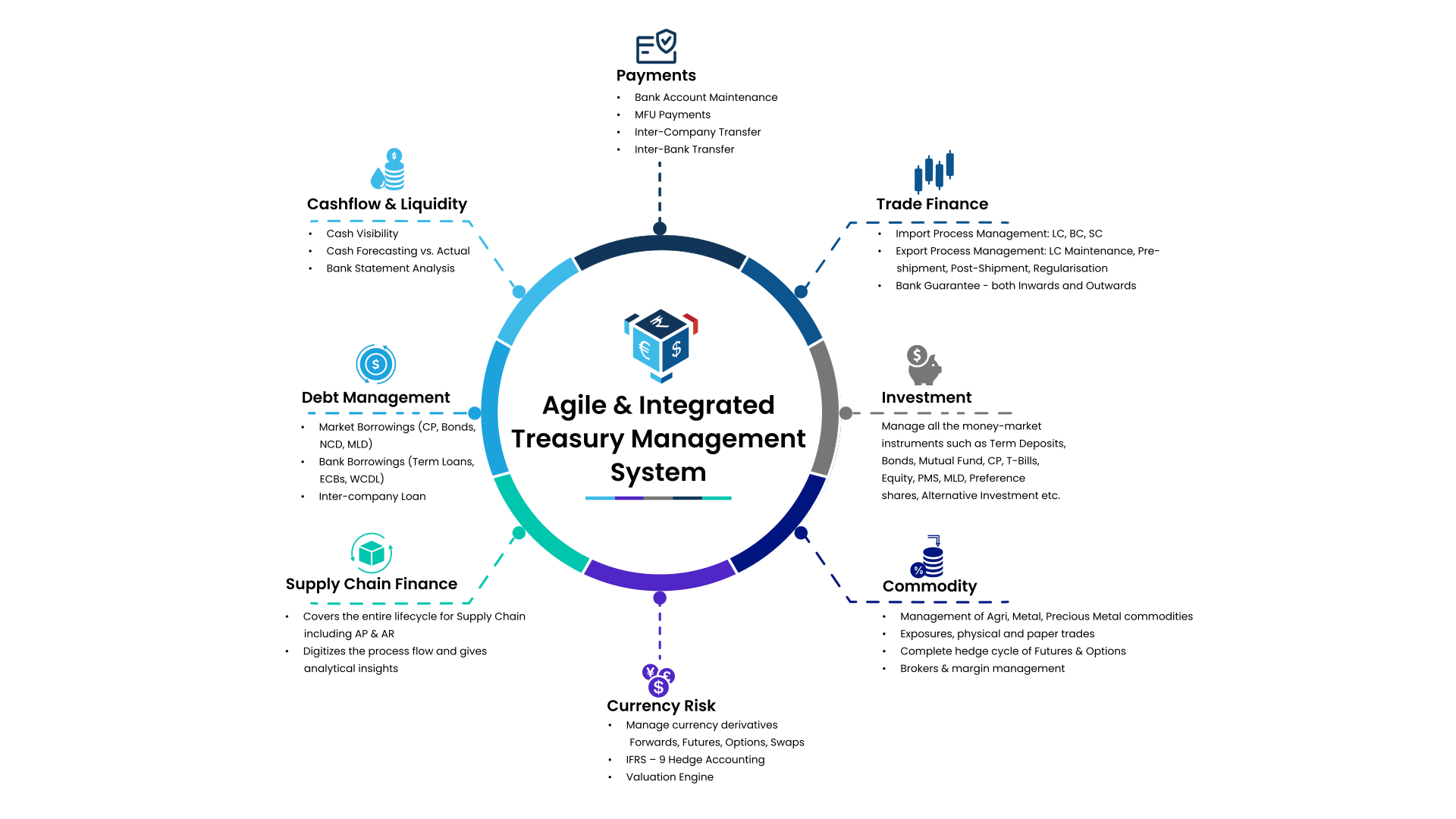
Here are the core functions that make a TMS essential for large enterprises:
-
Centralized cash and liquidity management
A treasury management system usually provides real-time visibility into cash positions across all bank accounts, currencies & legal entities all over the world. A treasury management system helps to see consolidated cash positions in real-time, track intercompany balances, forecast liquidity needs across regions & optimize cash deployment.
-
Comprehensive foreign exchange risk management
Large organisations face constant exposure to fluctuations in currency. It helps treasury teams monitor net exposure by currency, track hedge ratios, manage forward contracts & options, and analyse the impact of currency movements on financial results.
-
Investment management
Every large organisation maintains substantial cash reserves that need to be invested properly. A treasury management system tracks all investment instruments including money market funds, commercial paper, certificates of deposit, and treasury bills across different entities and currencies. It helps treasury teams quickly identify upcoming maturities, reinvest surplus funds efficiently and maintain optimal liquidity while maximizing returns on excess cash.
-
Global trade finance control
Every organisation engaged in international trade needs to manage hundreds of letters of credit, bank guarantees, shipping guarantees, and documentary collections. A Treasury Management System centralizes all trade finance instruments, tracks issuance and expiry dates, monitors utilization against approved limits, manages documentation workflows, and coordinates with banks across different countries.
-
Complex debt management
Large enterprises typically maintain diverse debt portfolios including syndicated loans, term loans, WCDL, ECB, bilateral credit facilities, revolving credit arrangements, commercial paper programs, and bonds. Each facility has different terms, covenants, interest rates and reporting requirements.
A TMS consolidates all debt information, tracks outstanding balances and available credit, calculates interest accurately across different rate structures, monitors covenant compliance, manages repayment schedules, and provides analysis for optimal debt structure decisions.
-
Commodity risk management
Corporations with significant exposure to commodity prices need to actively manage this risk. A TMS helps track commodity exposure across the organization, monitor price movements in key commodities, manage hedging instruments like futures and options, and analyse the impact of commodity price volatility on margins and cash flows. Usually, commodity prices are quoted in USD and the forex risk needs to be tracked.
This is particularly important for manufacturing conglomerates, energy companies, and organisations with substantial raw material costs where commodity price swings can significantly impact profitability.
-
Supply chain finance optimization
Multinational corporations can use TMS capabilities to implement supply chain finance programs that benefit both the company and its suppliers. The system provides visibility into payables across all entities, enables dynamic discounting programs where suppliers receive early payment in exchange for discounts, supports reverse factoring arrangements, and optimizes working capital across the supply chain. This requires integration with SCF platform which has companies, suppliers, financiers participating in the platform. This strengthens supplier relationships while improving the corporation's cash conversion cycle and working capital efficiency.
Empower your treasury operations with IBSFINtech Treasury Management System
Treasury operations become more complex, corporates need to transform their treasury function using intelligent platforms. A modern treasury management system helps treasury teams move beyond fragmented tools and manual processes towards more connected and streamlined operations.
IBSFINtech treasury management system helps corporations manage multi-entity, multi-currency and multi-location treasury environments through a unified digital platform. With right technology foundation, treasury teams will be able to shift their focus from operational function to strategic financial decisions. The solution has enabled treasury transformation for over 600+ entities including marquee conglomerates like Maruti Suzuki, Mahindra & Mahindra, Patanjali Foods, Puravankara, Credit Saison & Wipro Enterprises.